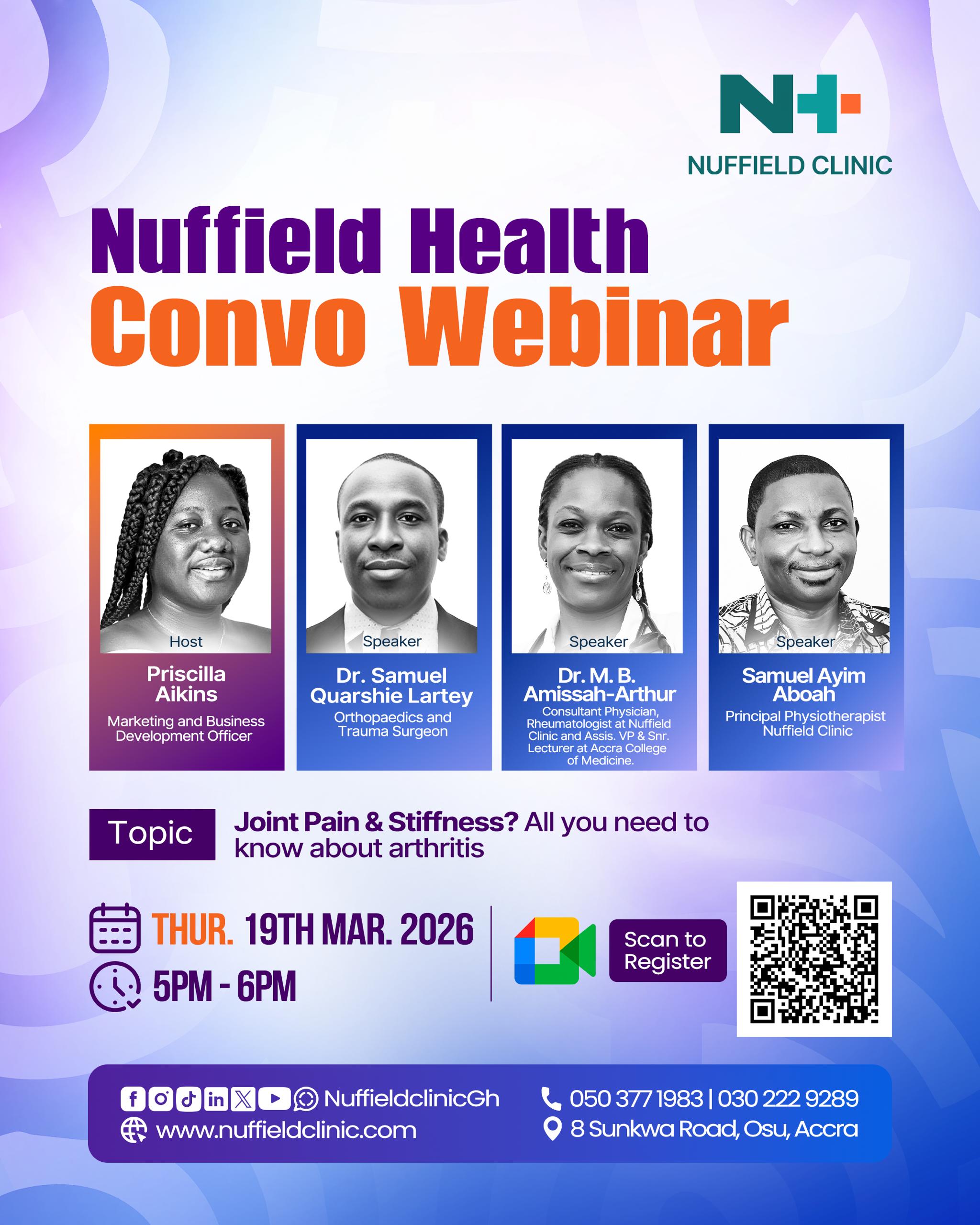
Arthritis remains one of the most misunderstood yet widespread health conditions affecting millions of people globally. In a recent educational session, the Nuffield Health Convo Webinar delivered a comprehensive and practical breakdown of arthritis, bridging the gap between medical science and everyday patient experience.
This review highlights the key insights from the webinar, evaluating its relevance, clarity, and real-life applicability, particularly for patients seeking to better understand joint health and long-term management.
You can watch the full webinar below;
Explaining Arthritis
One of the most commendable aspects of the webinar was its ability to simplify complex medical concepts without losing depth. Rather than presenting arthritis as just “joint pain,” the session clearly explained it as a condition involving inflammation, cartilage breakdown, and structural joint damage.

The discussion of joint anatomy stood out as especially valuable. By breaking down the roles of cartilage, synovial fluid, ligaments, and bone surfaces, the webinar helped patients understand why pain occurs.
This approach is critical because patients who understand the mechanics of their condition are more likely to adhere to treatment plans and lifestyle changes.
Arthritis Is Not One Disease
A major strength of the webinar was its emphasis that arthritis is not a single condition but a broad category of diseases with different causes.
The session clearly distinguished between:
- Degenerative conditions like osteoarthritis
- Autoimmune diseases such as rheumatoid arthritis and lupus
- Metabolic conditions like gout
- Infectious arthritis, which requires urgent care
This distinction is often overlooked in public health discussions, leading many patients to assume all arthritis is simply age-related. The webinar effectively corrected this misconception, reinforcing that arthritis can affect anyone, including children.
Early and Proper Assessment
Another strong point was the emphasis on early diagnosis. The webinar highlighted how many patients delay seeking medical care, often relying on home remedies until the condition worsens.
By explaining diagnostic tools such as X-rays, blood tests, and advanced imaging (MRI and ultrasound), the session reassured patients that arthritis can be accurately identified and monitored.
Importantly, it also clarified that:
- X-rays show bone damage and joint space narrowing
- Advanced imaging reveals soft tissue damage that may not be visible otherwise
This level of detail helps patients appreciate the importance of proper clinical evaluation rather than self-diagnosis.
A Practical and Realistic Framework
Perhaps the most impactful takeaway from the webinar was its strong emphasis on a team-based approach to arthritis care.
Instead of presenting treatment as a single pathway, the session highlighted the roles of:
- Rheumatology, for managing autoimmune and inflammatory causes
- Orthopaedics, for structural damage and surgical solutions
- Physiotherapy, for strengthening and restoring joint function
This integrated model reflects real-world best practice and is especially important in contexts like Ghana, where patients may move between different care providers without coordination.
The webinar effectively communicated that no single specialist can manage arthritis alone; optimal care requires collaboration.
Correcting a Dangerous Myth
One of the most valuable patient-centred insights was the clear rejection of the common belief that arthritis requires prolonged rest.
The webinar strongly emphasised that:
- Rest is only beneficial during acute flare-ups (usually not beyond 72 hours)
- Prolonged inactivity weakens muscles and worsens joint instability
- Movement, when guided properly, acts as “medicine” for the joints
This message is particularly relevant for many patients who unintentionally worsen their condition by avoiding movement due to fear of pain.
The inclusion of simple, practical desk exercises, such as knee extensions and ankle flexion, added immediate value, especially for office workers and sedentary individuals.
Addressing the Fear and Misconceptions
The webinar also tackled one of the most common fears among arthritis patients: joint surgery.
By presenting joint replacement as a safe and highly successful option, rather than a last resort to be feared, the session helped reframe public perception.
Key insights included:
- Joint replacements can last 20 to 30 years
- Most patients regain independence and live pain-free
- Complications are relatively rare compared to the benefits
This is particularly important in African settings, where cultural hesitation and misinformation often delay life-changing surgical interventions.
What About Children
A notable strength of the webinar was its attention to arthritis in children, a topic that is frequently ignored.
By highlighting that children, even as young as three, can develop arthritis, the session encouraged early medical evaluation for persistent joint pain or limping.
This is especially relevant in Ghana, where such symptoms may be misattributed to minor injuries or conditions like growing pains, delaying proper diagnosis.
Nuffield Health Convo Webinar
While the webinar was globally informed, its lessons translate strongly into the Ghanaian context:
- Many patients delay hospital visits due to reliance on self-treatment
- Physiotherapy is underutilised despite its effectiveness
- There is widespread fear of surgery
- Sedentary lifestyles and poor ergonomics are increasing joint problems
By addressing these realities, directly or indirectly, the webinar provided practical guidance that patients can apply immediately.
Well-Rounded, Patient-Centered Resource
We believe the Nuffield Health Convo Webinar succeeded in delivering a balanced, evidence-based, and highly practical overview of arthritis.
Its strengths were in its:
- Clear explanation of joint anatomy and disease mechanisms
- Strong emphasis on early intervention
- Promotion of a multidisciplinary care model
- Practical lifestyle advice, especially around movement
- Addressing myths and fears, particularly around surgery
Most importantly, the webinar reinforces a powerful message:
Arthritis is not a life sentence of immobility; it is a manageable condition. With the right combination of medical care, physiotherapy, and informed lifestyle choices, patients can maintain mobility, independence, and a high quality of life.